Featured

That’s Him!


“That’s him!” whispered Doss as soon as he put the spotting scope on this buck. We were hunting this one specific buck and I did not want to make the mistake of shooting the wrong one! My long time young friend Doss Summers and Guide on this trip knows every shootable and NON shootable buck on this 13,000 acre low fence Ranch in LaSalle County, Texas. This Ranch has only been hunted in the past by family, charity and youth hunts, and Military and Wounded Warriors. This last Summer, Doss had told me that for the first time ever that a very few hunts would be sold. I asked him to put me on the list for a good buck!

The Hixon Ranch is MLD permitted so we could have started hunting in October, but other Ranch commitments and the weather put off this hunt until the weekend before Thanksgiving. We also needed a North wind. I had been watching the weather forecast for weeks and finally it looked like a strong enough front would come through Thursday night, November 21st. I drove the the 5 hour trip on Thursday and we hunted a different location that afternoon. We saw a big Axis buck and a nice young 10 point buck-on the NO Shoot list. Overnight, the wind turned to out of the North; we went to the stand where this buck was most likely to be seen. A long morning and a long afternoon in the blind and this buck was not there today. Again, Saturday morning, we were in the blind at 5:50 AM and we both took a nap. Legal shooting time in Texas is 30 minutes before sunrise, which would be 6:35 AM. I woke Doss up at 6:30 and we looked out.There were 2 small bucks right in front of us. About 6:35, I saw a buck come out on the road about 200 yards in front of us. Not him. I think Doss dozed off again, because at about 6:40 I said “ there is another deer coming in from the right”. As Doss put the spotting scope on him-immediately, he said “That’s him”. I still could barely tell it was a buck with my binoculars. Both these bucks were moving slowly down the road towards us, slowly getting closer. Now 170 yards. Doss suggested I put the binoculars down and get him in the scope. “Can you see him well enough to shoot?”. “Yes”. “Then, you need to be shooting first good opportunity”. Well, first, the little 8 point is in the way; then my buck is facing us; then facing away; then the 8 point is in the way. After 10 minutes of this, he turns broadside. I shoot; he runs off. I was sure he was hit, but I was not sure how well. He runs to the left and within 10 yards is behind trees. We did not see him come out anywhere.

Doss suggests we wait 20 minutes before going to look. For 20 minutes we scanned every inch with binoculars and spotting scope. We could not see any downed deer. We started out about 10 minutes after sunrise; went to where he was standing and no blood and no dead buck in sight. I walked about 40 yards the way I thought he had run and no buck. Now, go back to where he was standing and look for blood; finally, about 2 drops! I take off that way again and no dead buck. Another circle and we are not finding any more blood or a deer. I am getting anxious and just about ready to ask Doss to text Mike, the Ranch Manager, and tell him to bring Charlie, the ranch blood dog. Then about 20 yards away, where we are not looking, I spot an antler tip sticking out above the knee high grass. “There he is”. What a relief! A heart/lung shot and he ran the 40 yards- just at a right angle to the direction we thought he went. All this only took about 10-12 minutes, but it seemed like an hour.

We get our pictures and get this buck off to the cooler.

Hunting a very specific buck is a different kind of challenge. You have to know what he looks like and be able to recognize him on sight.

Now, about the very special rifle I was using- the Joe Clayton Classic; a Ruger No.1A in 280 Ackley Improved with a 25” barrel. I was able to get Ruger to make a 125 rifle run to honor my long time friend and Ruger No.1 mentor- Joe Clayton. They are serially numbered JDC-001 through -125. Joe wrote the book on Ruger No.1 rifles in 1983 and was the first serious collector of these classic rifles.

Featured

Ruger No. 1 “Joe Clayton Classic”

The Ruger No.1 Joe Clayton Classic is finally a reality after a year in the works. Joe’s new favorite caliber is the 280 Ackley Improved; that was the first hurdle in getting Ruger to chamber a new cartridge for them. Secondly, the 25″ A weight barrel; never done before except on the Chester Hape rifle in 1968. Shown is serial# JDC-041.


The “standard” 1A with the 22″ barrel is one of the special runs for Cabela’s in 30/40 Krag is shown for comparative purposes.

$1700 +$40 for shipping to your FFL. Serial numbers are JDC-001 through JDC-125*. Recently, Ruger was trying to run the No.1 production line in January/February. Jason at Lipsey’s was going to order a few of Previously made models and I ordered 30 more of the 280 Ackleys. They were supposed to be in the regular serial# series(134-54XXX), but they came in as JDC-126 thru 155. Good news is, wood is near spectacular, so I will be shipping these before the last 12 of the rifles which were under #125.

The Box label
Serial# JDC-041(SOLD)
The Caliber Rollmark
Serial number marking
Comparison with a 22″ barrel 1A and the 25″ barrel 1A 280 Ackley IMproved
25″ vs. 22″
My personal rifle JDC-010 (Not For Sale)
JDC-010
JDC-010

The 21 Club Ruger No. 1’s

The Ruger No. 1 engraving project has already been covered to some extent in the article entitled “The Engraved Ruger No.1’s”.

Now, specific information and photographs will be presented concerning the “21 Club” rifles that I have knowledge of.
Joe Clayton tells us in the Ruger No.1 book on page 125:
“No factory engraved rifles were ever produced by the Company except for the “21 Club” rifles and other special presentation rifles.” Pictures of the receiver engraving on the John Amber rifle, serial # 9, are shown on pages 124 and 125.
There has been a lot of discussion about the “21 Club” designation; some mistakenly believing that there were only 21 rifles made.  The Clayton book tells us there were up to about 35.  Based on long ago conversations with Steve Vogel, I believe the term was a special notation applied to the No.1 rifles that were to have the special treatment of presentation inscriptions or engraving.  Also about this time, the 21 Club, an exclusive restaurant in New York City was a favorite of Jack O’Connor, as he mentioned it more than once in his writings.
First, a couple of old photographs from the collection of Pete Brown.
John Olin with Gun Writers John Olin with Four of the Big Time Old Gun Writers

This is Jack O’Connor (Outdoor Life), John Olin, Warren Page (Field&Stream), Pete Kuhlhoff (Argosy) and Pete Brown (Sports Afield).  This photo must date to the early ’60′s, as John Olin appears to be holding a Pre-64 Winchester Model 70 Featherweight. Wish I had a photo of Bill Ruger showing a Ruger No.1 to this same group!

These four Writers all got “21 Club” Ruger No.1 rifles engraved by A. A. White.

Writers

Writers at First Winchester Semina

Writers at First Winchester Seminar, Nilo Farms, Illinois in January, 1960

This group is: Top Row, L to R; Bill Edwards(Guns), John Amber(Gun Digest), Pete Kuhlhoff(Argosy), Warren Page(Field&Stream), Jack O’Connor(Outdoor Life), Elmer Keith(Guns). Bottom Row, L to R; Ray Ovington(Guns&Game), Larry Koller(Guns&Hunting), Tom Siatos(Guns&Ammo), Pete Brown(Sports Afield), Jack Seville(Sports Afield).

The rifles known to me will be discussed in serial # order.
They are:

The Herb Glass rifle, serial # 8,

A .243 Winchester, 26” B weight barrel and semi-beavertail forearm, shipped December 18, 1969. The 2 Glass rifles are different from the Writer’s rifles. The Glass rifles have gold on both sides, in that animal is in gold. Both rifles have a whitetail deer, #8 is in a sneak profile and #16 is leaping over a log.  The gold initials are on the opposite side(right) from the Writer’s rifles and are of a different script. Both have the same style of engraving as the Writer’s rifles, but slightly increased coverage, with the serial# also in gold.

The John Amber rifle, serial# 9,

A 7mm Remington magnum, 26” B weight barrel, Alex Henry forearm and sights, shipped April 4, 1968.

The John Amber Rifle, Right Side

From the 1969 Gun Digest; the caption gives no clue as to what the rifle really was!

The Warren Page rifle, serial# 13,

A .222 Remington, 26” B weight barrel and semi-beavertail forearm, shipped April 4, 1968.

The Elmer Keith rifle, serial# 15,

A .375 H&H Magnum, 24” C weight barrel with sights and an Alex Henry forend, shipped October 16,1969.

Elmer Kieth Left Side

Left Side of the Elmer Keith rifle

The Elmer Keith rifle differs from the other writers No.1’s, in that his entire name is spelled out, rather than just initials. This was per Steve Vogel’s instructions in a letter dated 8/4/1969 to the attention of Larry Wilson of A. A. White Engravers, Inc..  Also, the animal vignette is on the left side, with the name on the right side, different from all the other Writer’s rifles.

Elmer Keith Right Side

Right Side of the Elmer Keith rifle

Elmer Keith Engraving Letter

Elmer Keith Engraving Letter

The Elmer Keith rifle is on display among many of his firearms and trophies at the Cabela’s in Boise, Idaho.  Many thanks to my friend Randy Graham for taking these photos, with the assistance and permission of Justin Davis, Gun Library Manager.

Note the Conetrol bases and rings, rather than Ruger rings, and the modified front sight.

The Grizzly Bear vignette was requested by  Steve Vogel and is only one of 2 bear engraved by A. A. White on the Ruger No.1’s.

For many years, I have had a Business Card of Larry Wilson’s  when he was the Managing Director, with a Grizzly Bear rubbing on the back.  I never knew which rifle it was from until I saw Randy’s pictures. It is clearly from the Keith rifle!

Engravers-Card


A.A. White Engravers Card

Engravers-Card-Rubbing Grizzly Bear Rubbing

One of the most oft referred to articles concerning the Ruger No.1 is by Elmer Keith and has to do with the neoprene washer under the forearm screw. This was published in September, 1971 issue of Guns & Ammo.

I will quote a few specific paragraphs about the forearm screw and why the front sight was replaced/modified.

“Many complained of these fine rifles walking their groups vertically.  In about all cases, this was due to too heavy a pressure on the barrel from the forend tip, caused by tightening the forend screw too much. Bob Ray of Seattle, and some of his gunsmith friends, found that by putting the forend bolt through a neoprene washer and turning it up snug, then firing a few groups after which they tightened the bolt thoroughly, they could make those rifles deliver tackhole accuracy. Many Ruger No.1 rifles shot perfectly as they came from the factory and some did not.

The first Ruger single shot I received was in caliber .375 H&H. It shot well just as it came from the factory.  >>Then, to see what would happen, I tightened the forend screw as far as it would go with a heavy screwdriver, >>Results, it simply walked right off the top of the target in 5 shots as the barrel warmed up.

I found that the gold bead front would hook in the lining of my Boyt saddle scabbards, so had it changed to a sourdough front on the .375”

The Modified Front Sight Blade

Serial# 15 Closeup

Right Side Buttstock

Buttstock Right side

On Display at Cabela’s – Boise,ID

The following photo of Elmer Keith with his “21 Club” No.1 was taken in his home about 1975 and belongs to Dick Thompson of Idaho. The Elmer Keith is clearly visible on the right side of the receiver.The scope  and Factory Ruger rings are different than the way the rifle is currently displayed at Cabela’s in Boise. Dick, Thanks for permission to use your photo.

Elmer Keith and his “21 Club” No.1, taken in his Trophy Room

The 2nd Herb Glass rifle, serial# 16,

A .243 Winchester with a 26” B weight barrel and an Alex Henry forearm, shipped  September 26, 1969. Mr. Glass was President of A. A. White Engravers, a very close friend of Bill Ruger and I would not believe them to be actual Ruger presentation rifles. However, this #16 was made up for one of Herb Glass’s better known antique arms clients.

The Roger Barlow rifle, serial# 18,

A 7mm Remington Magnum with a 26” B weight barrel and an Alex Henry forearm, shipped December 10, 1968.

Roger Barlow Rifle Factory Letter

Factory Letter from Steve Vogel on the Roger Barlow “21 Club” No.1 rifle.

The Pete Kuhlhoff rifle, serial# 19,

Right side of Pete Kuhlhoff rifle

A 7mm Remington Magnum with a 26” B weight barrel and semi-beavertail forearm, shipped December 13, 1968.

Elbert Herman Kuhlhoff was born April 29, 1903 in Kansas.   He grew up in Oklahoma City.  Elbert owned a rifle and was a gifted marksman. His other interest was art; he drew a lot and enjoyed art classes in high school.  He studied art on weekends at the Oklahoma City Art Museum, and in 1922, his art work(cartoons) were first published in the humor magazine, Judge.

In 1929 he moved to Mamaroneck, NY, near a popular location for professional illustrators.  By 1930, Kuhlhoff was finding freelance work drawing interior story illustrations and painting covers for pulp magazines.  Most of his work was signed E. H. Kuhlhoff, but the artist preferred to be called “Pete” instead of Elbert.  By the early 1950′s , Pete was with Popular Publications when Argosy was converted into a men’s adventure magazine and Pete Kuhlhoff became an editor. He wrote and illustrated technical articles about guns and ammo for the rest of his life.

Left Side of the Pete Kuhlhoff rifle

One book, Kuhlhoff on Guns, was published by Winchester Press in 1970. It was a compilation of selected articles that had appeared in Argosy magazine.  Pete Kuhlhoff died in Middletown, CT, at the age of 68 on February 9, 1972.

Photos of the Pete Kuhlhoff rifle graciously provided by the owner, who wishes to remain anonymous.

The Jack O’Connor rifle, serial #20,

A .375 H&H Magnum with a 24” C weight barrel, semi-beavertail forearm and sights, shipped December 13, 1968.

Jack O’Connor Rifle Left Side

This same rifle is pictured at the bottom of page 58 of O’Connor’s The Hunting Rifle, with the right side shown.  The engraved sheep is visible in the photo, but there is no indication in the caption of what this special rifle was. Note that the front scope ring is one of the early vertical split rings, while the rear ring is of the early horizontal split type.

The Robert Chatfield -Taylor rifle, serial#21

This rifle was supposed to have gotten the engraving treatment for Chatfield-Taylor, but for some reason it did not. It could have been that Chatfield-Taylor was in a big hurry for it, as it went to him on September 18, 1967. This was several months before the engraving work by A. A. White.

It was originally shipped as a .280 Remington with a semi-beavertail forearm and a 26″ medium weight barrel. It is not that way today; it is now a 7x65R with sights and the Alex Henry style forearm. The forearm dates this work to about 1970; I am as sure as I can be that the work was Factory done for WBR’s good friend.

The number #22 rifle,

I have always believed that this serial# and rifle was to have been engraved forLarry Koller. He died in August of 1967, before this rifle was even made. #22 is a 7mm Rem. Mag. with a 26″ medium weight barrel, with a later 1970 style Alex Henry forearm and is not engraved.

Larry Koller Memoriam from a Guns & Hunting

The front sight is not grooved for a hood and the forearm is of the later style of 1970. In his Testfires of the Prototype No. 1′s, Koller alluded to the plan that he would have a 7mm Rem. Mag. when the regular production rifles were made.

The Pete Brown rifle, serial# 23,

A 7mm Remington Magnum with a 26” B weight barrel and semi-beavertail forearm, shipped April 14, 1968.

The Bill Lett rifle, serial# 24,

A .30-06 with a 26” B weight barrel, Alex Henry forearm and sights, shipped November 14, 1969.

The Peter Barrett rifle, serial# 33,

A .222 Remington with a 26” B weight barrel and semi-beavertail forearm, shipped March 13, 1970. This rifle has a fox engraved for the animal motiff and is of a totally different style than the other No.1s engraved by Alvin White. It is not signed by White, as are all the other rifles mentioned here that I have examined.

The R. L. Wilson rifle, serial# 3370,

A 7mm Rem. Mag. with the 22″ lightweight barrel, Alex Henry forearm and sights(front sight grooved for a hood).  The Wilson rifle only has the gold initialsRLW on the right side, with no other engraving. It is pictured on page 308 of the R. L. Wilson book  STEEL CANVAS -The Art of American Arms.  Wilson shot a Lion in Africa with it in 1970, while researching his book on Theodore Roosevelt.

The RR rifle, serial#3437

I do not believe this rifle to have been  Factory commissioned work, but it is done by A. A. White and signed. It has been custom stocked by Joe Balickie; it is pictured in L.R. Wallack’s book The Deer Rifle on page 66. It is done in the style of the Glass rifles.

The Prince Abdorreza rifle, serial# unknown

The Charles Askins rifle, serial # , caliber and configuration unknown.

R. L. Wilson lists Col. Askins as a recipient  on page 89 of RUGER & His Guns.  I have been unable to locate any information as to the production  or existence of this rifle. I would certainly like to hear from anyone who has  information about this rifle.

Pictures and additional information on each of these rifles, where I have access to pictures and have the information will be added later.  Anyone who can add information or stories about these rare Ruger No.1’s are invited to contact the author.

A Tale of Two Bucks

The first game camera pictures from August showed these two bucks in velvet. One was Mr. Big and the other was the Old N.T., as this old Non-Typical was thought to be 10 1/2 years old. Both these bucks were semi-regular showing up at a blind tabbed as the Northwest(NW), in a low fence pasture of about 1300 acres. After my 2019 hunt, I had expressed an interest in a buck that would make the Boone & Crockett record book, which is a minimum net score of 170″. We thought Mr. Big, as a mainframe 11, with only two abnormal points might achieve this lofty goal. The best experts guessed him at 182″ gross and 172″ net, based on several pictures. After 6 1/2 days hunting during October and November not seeing Mr. Big, he was renamed Mr. No Show He was actually absent from any game camera pictures from October 24 until Christmas. When I returned in December, Doss Summers noted that the hunter that was hunting Old N.T. would not be able to return to hunt. “Was I interested in him?” I said, “Just let him show up!” We had briefly seen him about the 4th day of hunting, well before sunrise and only for a short time. He was not prone to hang around. That morning, he was the other hunter’s buck. At an estimated 10 1/2 years old, he was problematic to survive another year. With the extreme cold that all of Texas experienced in the middle of February, it is doubtful that he would have survived it. Exotic game, native game and livestock all died during this cold spell. The morning of December 15 was cloudy, overcast, and nearly foggy. So, at 10 minutes into legal shooting time(20 minutes before sunrise) and it was pretty difficult to see. He steps out of the brush and Doss immediately identifies him as the Old N.T.! I had my Joe Clayton Classic Ruger No.1 in 280 Ackley Improved with me. There was no seeing the reticule on the deer; just kind of centering him in the scope. I shot-and he ran off! Doss and I sat there a few minutes. Doss asked, “How do you feel about the shot?” “I don’t feel worth a damn about it”. I did not hear the impact of a hit, and as he ran off, I could see no indication that he was hit. It was dark though! Doss remarked that the run he observed appeared more of a startled run than an injured run. We sat there an hour and 15 minutes; talking very little. “Well, let’s go look!” When we got to where we thought he was standing at the shot-nothing! (We were
in the wrong place we saw later) It didn’t take long to find him piled up in a prickly pear patch, A near-perfect shot; he was able to run 40 yards, just out of our sight. To quantify the Old N. T., he is a mainframe 10, with 11 extra scoreable points and grossed 189 3/8″. I was still determined to hunt the B&C Typical. When Mr. No Show appeared on camera again, he had moved about a mile to a blind dubbed the Shooting Gallery(SG for short)We spent another 12 days hunting Mr. No Show at the SG and only laid eyes on him once. He was 475 yards away, in a road and mounting a doe! Doss and I just watched. We stayed in that blind near all day and he never showed again, He would be on camera the day before I arrived to hunt or the afternoon that I had left. In the end, he was back at NW. During all these hunts during January and February, a major pipeline was being laid about 200 yards from the SG. He moved back to NW and we hunted there until February 11 and I went home that afternoon. This was when the Texas Blizzard came through. It was the 22nd before I could even consider going back to Cotulla. We decided there was too much risk of him losing a horn(s)- shedding! By now, Mr. No Show has become Old SOB! He is showing up regularly now and has not shed yet. It is a Vendetta now and I will be back in October 2021!!

The Engraved Ruger No. 1’s

The 1967 Catalog stated(in very small print):

Engraving: Our engraving is done in the English pattern(i.e., floral scrolls and borders, monograms, game vignettes) but no bas-relief engraving will be undertaken. We cannot furnish inlays or carvings of stocks. Prices for engraving (3 patterns available) start at $125.00, which is in addition to the basic retail cost of the rifle. For details on engraving, please write to the factory.

If someone wrote to the factory for details (per last sentence above) on engraving, it is not clear to me what they would have received. If anyone has this information, I would certainly like to know of it. Three patterns were advertised starting at $125.00, but the cost of the other two patterns is not stated. Of the three engraved rifles discussed below, it does not appear that they were of three different styles and coverage, as all three 1967 NRA Show rifles(#954,#956 and #962) have the same style and coverage, excepting the animal vignettes.

For any number of reasons, no engraved rifles were ever sold in a public way. The Writers guns and several Presentation pieces were done by A. A. White and the Ruger Creedmoor rifle (cover of 1969 Gun Digest) by John Warren, but, alas, no others!

The plan was to have three engraved No. 1 rifles at the 1967 NRA Meetings in Washington D. C. A letter dated March 2, 1967 from Ed Nolan to Alvin White states “Yesterday we mailed three RUGER Single-Shot rifle frames to you for engraving, as per our conversation with Mr. Larry Wilson”. Each receiver was to have a different animal; a Bear, an Elk and a Bighorn Sheep. The serial #’s were 954, 956, and 962. Rifle #962 was auctioned on the Ruger Auction site and ended 2/05/08.

NRA Show Rifle # 962 NRA Show Rifle # 962

Serial #962 Right Side Closeup

Rifle #954 was auctioned on the Ruger Auction site and ended 6/8/2011
Ruger No.1 #954 Ruger No.1 #954

Rifle #956 is pictured in the R. L. Wilson book-Ruger & His Guns on pages 80 and 94. The Caliber/Configuration of these three rifles is the AB in .308 Winchester.

Ruger No.1 Serial #956, right Side Serial #956, right Side

All further references to page numbers will be for the Wilson book, Ruger & His Guns, unless noted otherwise. The rifle pictured below is #962 and is from a period A. A. White Engravers brochure and a R. L. Wilson article titled “Gun Engraving” in the GUNS & AMMO 1969 Annual. The caption to this picture on page 204 of the GUNS & AMMO Annual indicates the cost of this engraving to be “about $375 plus the cost of the rifle”. This was most likely the style with the most engraving coverage.

By April 10, 1967, an invoice for $600.00 ($200.00 each) was sent to attention of Ed Nolan. I do not have the information as to whether the receivers or completed rifles were on display at the Meetings. During the Summer and Fall of 1967, the project seems to have been put on hold. A letter dated 8/8/67 from Ed Nolan to Larry Wilson states: “Thanks for your note of July 25 about our plans for engraved presentation of Single-Shot rifles. I must confess that we have not given much thought to engraving since our last conversation, but we are certainly going to get to it as we can clear the decks of a few other matters.”By 1968, a proposal was made by A. A. White Engravers for the engraving project generally referred to as the “21 Club” rifles.

AA White “21 Club” Letter

The presentation inscription surrounding the gold initials was omitted, so that the engraving cost was $180.00-200.00, depending on whether 2 or 3 initials were used. Of the Writers listed on page 89(Warren Page-#13, John T. Amber-#9, Roger Barlow-#18, Pete Barrett-#33, Pete Brown-#23, Elmer Keith-#15, Pete Kuhlhoff-#19 and Jack O’Connor-#20) as receiving one of these rifles, I cannot confirm that Charles Askins was a recipient. There were others; note serial # 24 with the gold boar head for Bill Lett on page 93, which is a different engraving pattern than the Writer’s guns. The WBR rifle, serial #270 in .270 Winchester is pictured on pages 79, 227, 296, and 306. The caption on the rifle pictured on page 308 indicates it to be #270; a study of the photographs will show it is not. I now know(as of 4/5/2009) that this rifle is #222, a .222 Remington in the BHS configuration. This #222 has the later forearm checkering pattern and does not have a grooved front sight. The engraving is not signed, but I believe it to have been done by Alvin White. Notice that the forearm and forearm checkering on this rifle and #270 are of the 1969-1970 style. On page 89, two rifles are ascribed to Herb Glass; they are actually #8 and #16. Serial #9 was John T. Amber’s rifle. The Glass rifles have slightly more coverage than the rifles for the Writers and a gold Whitetail deer along with the gold initials. I have seen #8 and pictures of #16.

The Prince Abdorreza Ruger No.1 Rifle

A rifle was engraved by A. A. White for Prince Abdorreza, brother of the Shah of Iran. The serial# and caliber/configuration of this rifle is not known. The Prince was a noted Worldwide big game hunter, 1962 Weatherby Award Winner, and friend of Jack O’Connor and Bill Ruger.

Roy Weatherby with Prince Abdol Reza and Princess Para Cima; believed to be at the Weatherby Award Dinner where the Prince was the 4th Recepient of the Weatherby Award.

This rifle is pictured on page 216, lower left corner.

The drawing made by R. L. Wilson of the engraving pattern submitted to Bill Ruger for approval before the engraving was executed by A. A. White is shown below.

Prince Abdorreza Engraving Pattern Ruger No. 1 Prince Abdorreza Engraving Pattern


The sketch is matted and framed. Written on the back is:
Hadlyme, CT
Jan.16, 1989

For C. Lee Newton
This frame contains my design drawing for the Prince Abdol Reza Presentation No. 1 Ruger Rifle which was taken by Wm. B. Ruger to Iran for a thank you present on Bill’s hunt there. I met with WBR to discuss the design concept and then presented the idea to him-though I believe he may have thought of an Iranian Prince hunting on one side and an Indian warrior on the other.
This is one of my all-time favorite Alvin White guns—-With best regards and happy you are the owner of the drawing-Larry Wilson

I believe the hunt in Iran to have taken place in 1970. Some information is found in the February and March 1989 issues of Outdoor Life. There were two installments of the Jack O’Connor Letters which included excerpts from letters exchanged between O’Connor and Robert Chatfield-Taylor. These letters spanned a period of nearly 30 years. Following are excerpts from two that relate to this hunt in Iran by Chatfield-Taylor and Bill Ruger
(JO’C-3/11/70){Chatfield-Taylor had said he was planning a hunt in Iran–Jack’s reply} You would enjoy a hunt in Iran. When will you go? Eleanor and I are going to land in Iran around the last of October. Abdorreza{the prince} and Pari Sima{Abdorreza’s wife} were going to be in Paris for about a month, but they will come back to meet us. If you and Bill{Ruger} are over there when Abdorreza is home, I will ask his nibs to ask you up to see his trophies, for a drink and so on.
(J’OC–6/5/70) I have written Abdorreza to be on the lookout for you and Bill. You must have impressed him as he has asked about you several times, and I have given Bill quite a buildup.

Inscription on the Prince Abdorreza Ruger No.1 Rifle

Looks to be a Mershon recoil pad, but still no info as to serial# or caliber/configuration.

Will the owner of this rifle, who contacted me several years ago, please contact me again.

RUGER & His Guns by R. L. Wilson on page 106 shows Iranian guides admiring Ruger No. 1 rifle with International stock. The same No.1 International appears to be the one pictured in the gun cabinet on page 314. It is engraved here in this photograph, but the forearm sling attachment and checkering pattern appears to be the same; different from the later produced No.1 RSIs. On page 24 of Ruger No.1 by J. D. Clayton is noted:In 1970, Lenard Brownell made a special Mannlicher stocked No.1 rifle, chambered in the 7×57 cartridge, for Bill Ruger’s personal use. This rifle was brought to the NRA national meetings of that year and was seen and handled by a very small group of editors and friends of the Company. It was not on public display

Ruger M77 50th Anniversary “High Grade” Available Now

Ruger M77 50th Anniversary

The first M77 rifles were shipped in the Summer/Fall of 1968. First calibers offered were the 22-250, 243 Win., 6mm Rem. And 308 Win.

Terry Wolosek, the M77 man, has collaborated with the Factory to have a special High Grade Commemorative M77 produced. There will only be 77 made and they will be serial numbered 7750-00001 thru 7750-00077. They are only available as a Classic Sporting Arms Exclusive. Contact Terry to reserve yours at 715-572-1030.


2008 Mexico Hunt with Ruger No. 1AH .25-06

In field judging game, Jack O’Connor is often quoted: “The big ones always look big!” That quote is found at least in one place on page 326 in Hunting Big Game in North America. The December 1973 Petersen’s Hunting magazine contained an article titled “The Big Ones Look Big”.

I will remind myself of that many times on future hunts!

It was Friday, our last day to hunt. At 3:30 PM, I decided that the “Flaco Nueve” would be shot on sight. At 4:40, he stepped out of the brush, at about 125 yards, right where I had taken his picture some 5 hours earlier. I only put the binoculars on him long enough to ascertain that he had not broken off any points in the last 5 hours. Then I got my rifle into position with the steadiest rest I could in that old tripod.

This hunt all got started last July when I visited with Judge Joe Clayton in Tyler, Texas. I had gone to pick a supply of his new printing of the Ruger No.1 book. While admiring several of his whitetail mounts taken in South Texas and Mexico, the discussion naturally turned to deer hunting. Joe mentioned he had scheduled a Mexico hunt the first 5 days of January, 2008 and there might still be an opening.. I knew of the rains that nearly all of Texas received in the first 7 months of the year; I knew that rainfall is highly correlated to the number of B&C quality bucks taken in that year. It had to be a super year for taking big bucks in South Texas and Mexico. In anticipation, I had entered the Los Cazadores Big Buck Contest in Pearsall in December. I was returning from a trip to the Chaparral WMA. I also signed up for the Los Cuernos de Tejas Contest at Carrizo Springs.

Continue reading “2008 Mexico Hunt with Ruger No. 1AH .25-06”

The Ruger No.1A in .275 Rigby-A Lipsey’s 2016 Exclusive

Jack O’Connor wrote in the October, 1966 issue of Outdoor Life about the introduction and his testing of the new Ruger No.1 single shot rifle. He concluded the article with these words:  “I am going to try to sneak enough dough out of the budget for a Ruger No.1. It is to be a light, handy rifle for a lazy old man to hunt sheep with. I think it will be a 7×57, a 270, or a 280 with a 4x scope and a 24 or 26-in. barrel to weigh about 8 pounds complete. I wouldn’t want anything better!”(1)

Over 10 years later, J O’C wrote in Petersen’s Hunting magazine an article titled Sheep Rifles: Fast, Flat and Accurate-With a Punch.(2) He wrote:  “A rifle that I have had my eye on and would like to take on a sheep hunt is a Ruger No.1 single shot in .270, .280 or 7×57. Because it does not have the long receiver, a No.1 with a 24-inch barrel is about 4-inches shorter than a bolt-action rifle with a 22-inch barrel”

Continue reading “The Ruger No.1A in .275 Rigby-A Lipsey’s 2016 Exclusive”

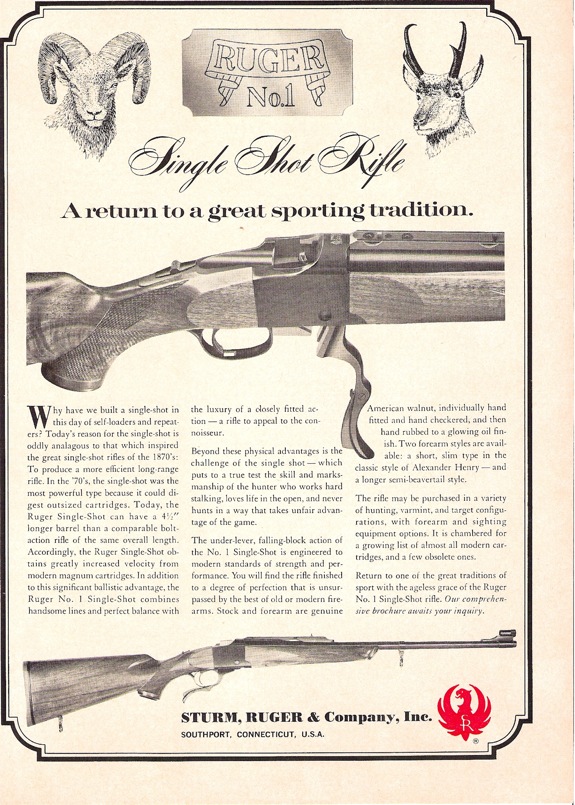
Ruger No.1 Advertising

Magazine advertisements featuring the No.1 rifle were first printed in 1967. An example of the first ad is featured below.

The Company's first advertisement for the the Ruger No.1 rifle featured a full photo of Prototype rifle #X-3, a 22-250. The view of the action is not identifiable yet.
The Company’s first advertisement for the the Ruger No.1 rifle featured a full photo of Prototype rifle #X-3, a 22-250.
The view of the action is not identifiable yet.

The last sentence, “Our comprehensive brochure awaits your inquiry” has always intrigued me. What did you get as a “comprehensive brochure” if you wrote for it?? After many years of searching, I have obtained a copy of what I believe was mailed out. It was basically and order form. The copy is presented below.

This is what I believe a requester got if they wrote to the Company for more information about the Ruger No.1 rifle

From 1967 until the end of 1969, a purchaser basically “custom ordered” their Ruger No.1, by specifying caliber, barrel weight and length, forearm style and sighting equipment: ie, no sights, sights, or target scope blocks.

In early 1970, the available calibers and configurations were standardized with those we still use today; the 1A, 1S, 1B, 1V and 1H.

This 1970 advertisement presented the 5 available configurations and utilized the Catalog Numbers of 1A, 1S, 1B, 1V and 1H.

In the order they were presented, these rifles were called the Light Sporter, Medium Sporter, Standard Rifle, Special Varminter and Tropical Rifle. To be continued.

Ruger No.1 at Corbin Park

By Lee Newton

The photo below was taken at Corbin Park, also called the Blue Mountain Forest and Game Preserve and/or the Blue Mountain Forest Association. The Park is very near Newport, New Hampshire. Pictured R-L, Ed Nolan (Ruger Sales Manager), Bill Ruger, Robert E. Petersen (Petersen Publishing), Knieland Wheeler (Blue Mountain Forrest Assoc. Caretaker). Man with Ruger No.1 rifle is not identified. (As of May, 2024, we believe this gentleman to be Palmer Read, Jr.)Photo was most likely taken Fall 1966(or 1967)at Corbin Park. Thanks to Mr. Howard Avery for furnishing and the use of this photo.

Bill Ruger and Group at Corbin Park with the new Ruger No.1. (R-L) Ed Nolan, Sales Manager; Bill Ruger; Robert E. Peterson, Peterson Publishing; Kneeland Wheeler, Caretaker at Corbin Park. Gentleman holding the new Ruger No.1 is not identified.
Bill Ruger and Group at Corbin Park with the new Ruger No.1.
(R-L) Ed Nolan, Sales Manager; Bill Ruger; Robert E. Peterson, Peterson Publishing; Kneeland Wheeler, Caretaker at Corbin Park. Gentleman holding the new Ruger No.1 is not identified.