
The Ruger No. 1 engraving project has already been covered to some extent in the article entitled “The Engraved Ruger No.1’s”.
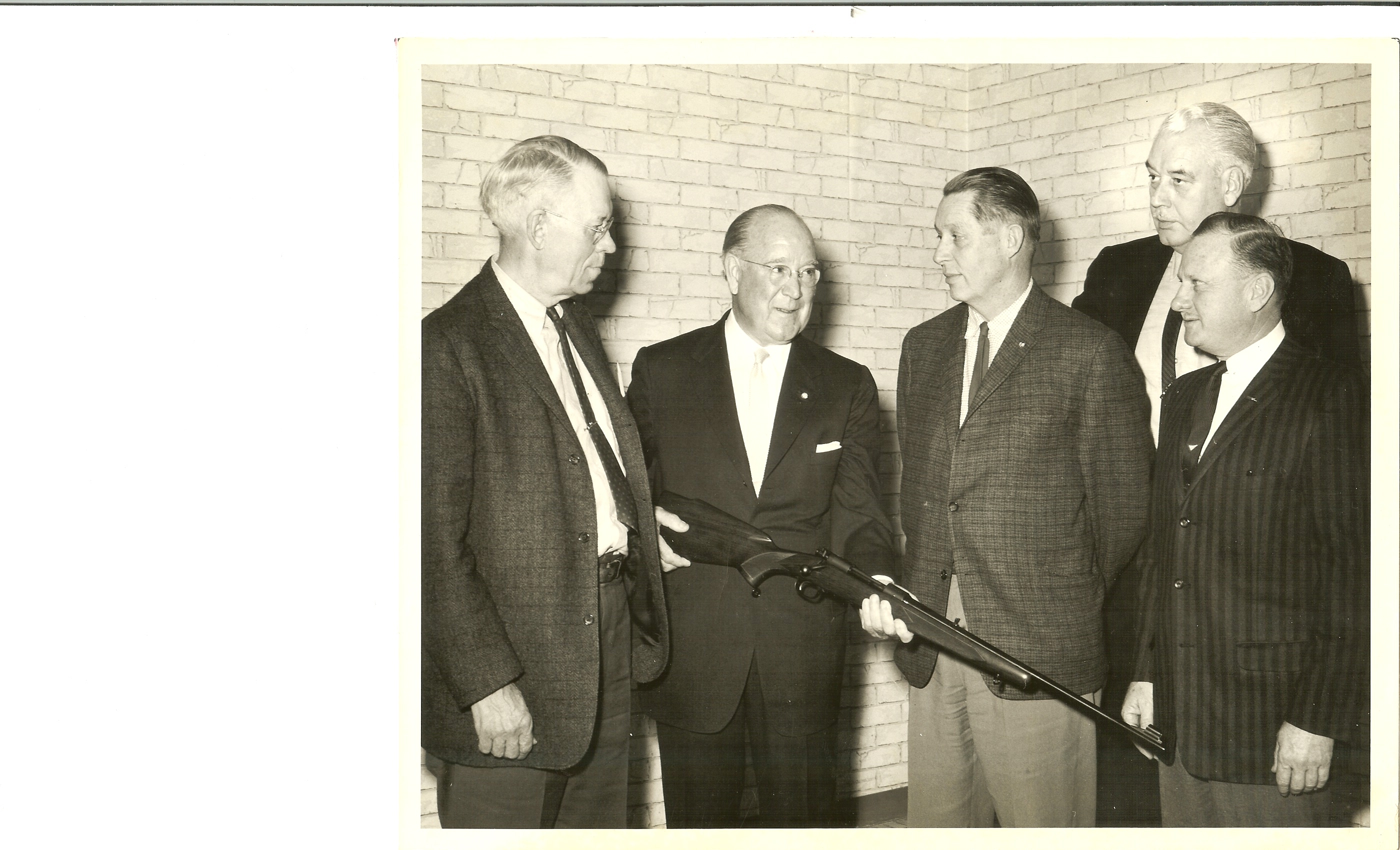 John Olin with Four of the Big Time Old Gun Writers
This is Jack O’Connor (Outdoor Life), John Olin, Warren Page (Field&Stream), Pete Kuhlhoff (Argosy) and Pete Brown (Sports Afield). This photo must date to the early ’60′s, as John Olin appears to be holding a Pre-64 Winchester Model 70 Featherweight. Wish I had a photo of Bill Ruger showing a Ruger No.1 to this same group!
These four Writers all got “21 Club” Ruger No.1 rifles engraved by A. A. White.
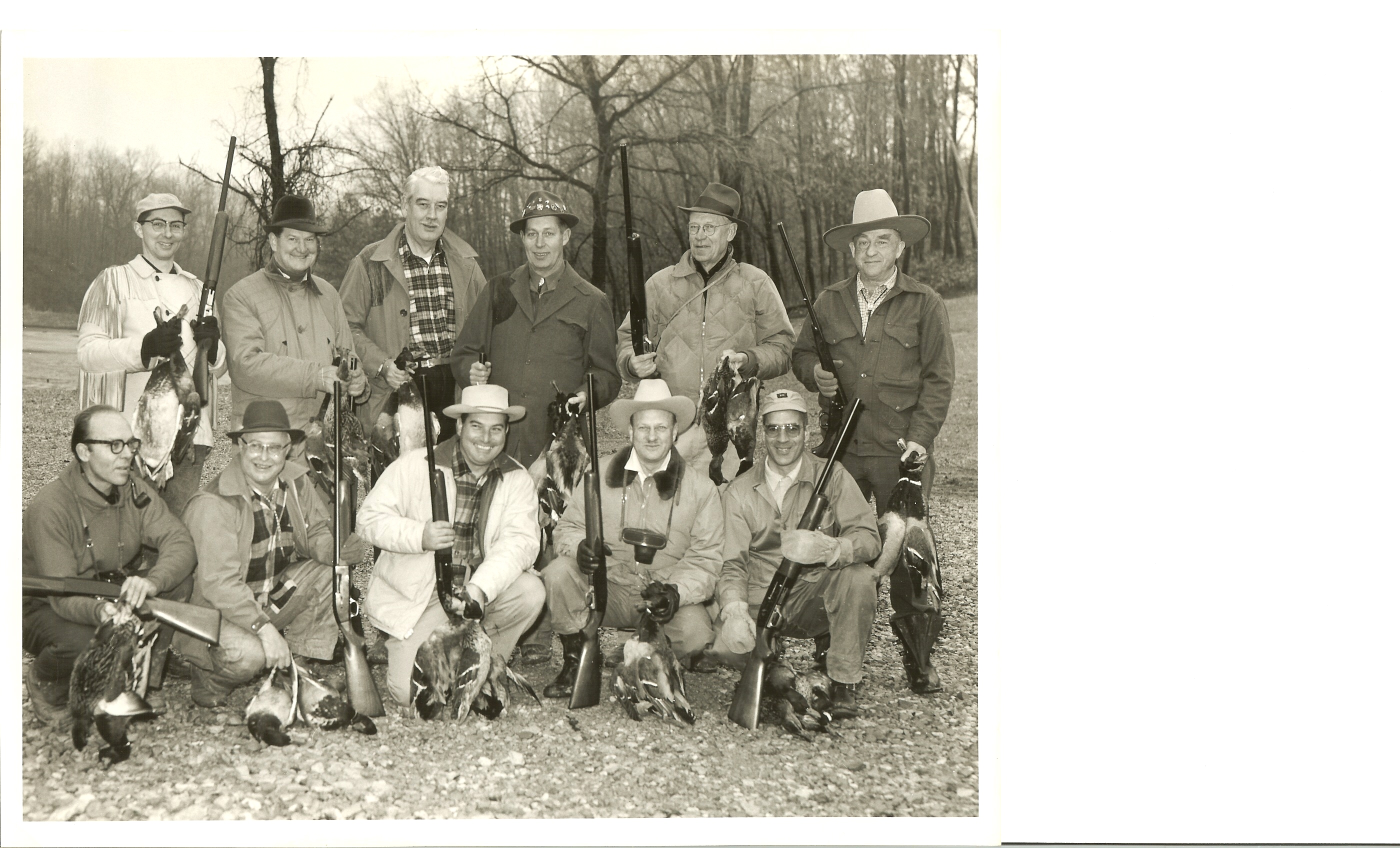

Writers at First Winchester Seminar, Nilo Farms, Illinois in January, 1960
This group is: Top Row, L to R; Bill Edwards(Guns), John Amber(Gun Digest), Pete Kuhlhoff(Argosy), Warren Page(Field&Stream), Jack O’Connor(Outdoor Life), Elmer Keith(Guns). Bottom Row, L to R; Ray Ovington(Guns&Game), Larry Koller(Guns&Hunting), Tom Siatos(Guns&Ammo), Pete Brown(Sports Afield), Jack Seville(Sports Afield).
The Herb Glass rifle, serial # 8,
A .243 Winchester, 26” B weight barrel and semi-beavertail forearm, shipped December 18, 1969. The 2 Glass rifles are different from the Writer’s rifles. The Glass rifles have gold on both sides, in that animal is in gold. Both rifles have a whitetail deer, #8 is in a sneak profile and #16 is leaping over a log. The gold initials are on the opposite side(right) from the Writer’s rifles and are of a different script. Both have the same style of engraving as the Writer’s rifles, but slightly increased coverage, with the serial# also in gold.
The John Amber rifle, serial# 9,
A 7mm Remington magnum, 26” B weight barrel, Alex Henry forearm and sights, shipped April 4, 1968.

The John Amber Rifle, Right Side
From the 1969 Gun Digest; the caption gives no clue as to what the rifle really was!
The Warren Page rifle, serial# 13,
A .222 Remington, 26” B weight barrel and semi-beavertail forearm, shipped April 4, 1968.
The Elmer Keith rifle, serial# 15,
A .375 H&H Magnum, 24” C weight barrel with sights and an Alex Henry forend, shipped October 16,1969.

Left Side of the Elmer Keith rifle
The Elmer Keith rifle differs from the other writers No.1’s, in that his entire name is spelled out, rather than just initials. This was per Steve Vogel’s instructions in a letter dated 8/4/1969 to the attention of Larry Wilson of A. A. White Engravers, Inc.. Also, the animal vignette is on the left side, with the name on the right side, different from all the other Writer’s rifles.

Right Side of the Elmer Keith rifle

Elmer Keith Engraving Letter
The Elmer Keith rifle is on display among many of his firearms and trophies at the Cabela’s in Boise, Idaho. Many thanks to my friend Randy Graham for taking these photos, with the assistance and permission of Justin Davis, Gun Library Manager.
Note the Conetrol bases and rings, rather than Ruger rings, and the modified front sight.
The Grizzly Bear vignette was requested by Steve Vogel and is only one of 2 bear engraved by A. A. White on the Ruger No.1’s.
For many years, I have had a Business Card of Larry Wilson’s when he was the Managing Director, with a Grizzly Bear rubbing on the back. I never knew which rifle it was from until I saw Randy’s pictures. It is clearly from the Keith rifle!
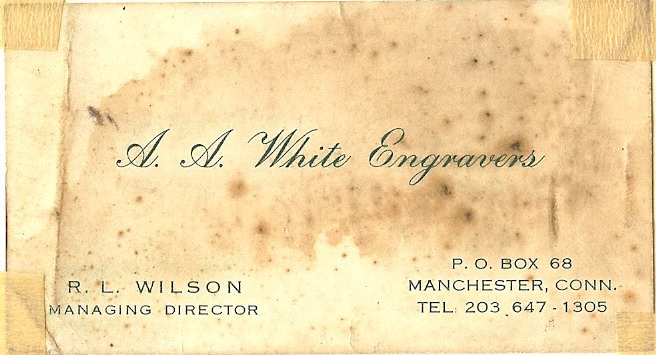
A.A. White Engravers Card
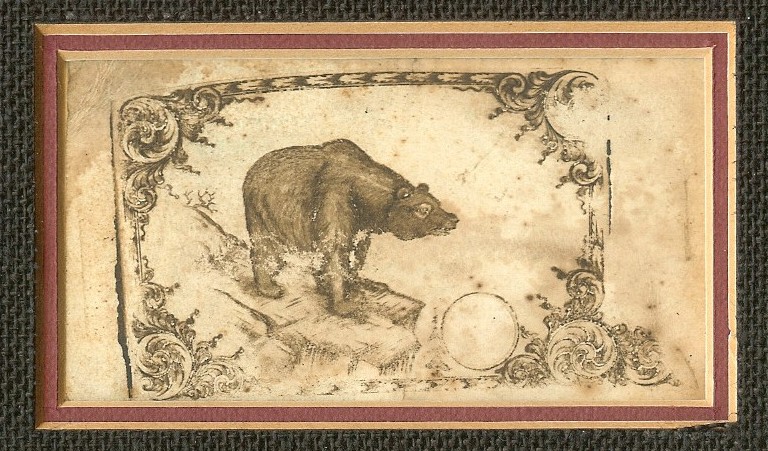 Grizzly Bear Rubbing
One of the most oft referred to articles concerning the Ruger No.1 is by Elmer Keith and has to do with the neoprene washer under the forearm screw. This was published in September, 1971 issue of Guns & Ammo.
I will quote a few specific paragraphs about the forearm screw and why the front sight was replaced/modified.
“Many complained of these fine rifles walking their groups vertically. In about all cases, this was due to too heavy a pressure on the barrel from the forend tip, caused by tightening the forend screw too much. Bob Ray of Seattle, and some of his gunsmith friends, found that by putting the forend bolt through a neoprene washer and turning it up snug, then firing a few groups after which they tightened the bolt thoroughly, they could make those rifles deliver tackhole accuracy. Many Ruger No.1 rifles shot perfectly as they came from the factory and some did not.
The first Ruger single shot I received was in caliber .375 H&H. It shot well just as it came from the factory. >>Then, to see what would happen, I tightened the forend screw as far as it would go with a heavy screwdriver, >>Results, it simply walked right off the top of the target in 5 shots as the barrel warmed up.
I found that the gold bead front would hook in the lining of my Boyt saddle scabbards, so had it changed to a sourdough front on the .375”

The Modified Front Sight Blade

Serial# 15 Closeup

Right Side Buttstock

Buttstock Right side

On Display at Cabela’s – Boise,ID
The following photo of Elmer Keith with his “21 Club” No.1 was taken in his home about 1975 and belongs to Dick Thompson of Idaho. The Elmer Keith is clearly visible on the right side of the receiver.The scope and Factory Ruger rings are different than the way the rifle is currently displayed at Cabela’s in Boise. Dick, Thanks for permission to use your photo.

Elmer Keith and his “21 Club” No.1, taken in his Trophy Room
The 2nd Herb Glass rifle, serial# 16,
A .243 Winchester with a 26” B weight barrel and an Alex Henry forearm, shipped September 26, 1969. Mr. Glass was President of A. A. White Engravers, a very close friend of Bill Ruger and I would not believe them to be actual Ruger presentation rifles. However, this #16 was made up for one of Herb Glass’s better known antique arms clients.
The Roger Barlow rifle, serial# 18,
A 7mm Remington Magnum with a 26” B weight barrel and an Alex Henry forearm, shipped December 10, 1968.

Roger Barlow Rifle Factory Letter
Factory Letter from Steve Vogel on the Roger Barlow “21 Club” No.1 rifle.
The Pete Kuhlhoff rifle, serial# 19,

Right side of Pete Kuhlhoff rifle
A 7mm Remington Magnum with a 26” B weight barrel and semi-beavertail forearm, shipped December 13, 1968.
Elbert Herman Kuhlhoff was born April 29, 1903 in Kansas. He grew up in Oklahoma City. Elbert owned a rifle and was a gifted marksman. His other interest was art; he drew a lot and enjoyed art classes in high school. He studied art on weekends at the Oklahoma City Art Museum, and in 1922, his art work(cartoons) were first published in the humor magazine, Judge.
In 1929 he moved to Mamaroneck, NY, near a popular location for professional illustrators. By 1930, Kuhlhoff was finding freelance work drawing interior story illustrations and painting covers for pulp magazines. Most of his work was signed E. H. Kuhlhoff, but the artist preferred to be called “Pete” instead of Elbert. By the early 1950′s , Pete was with Popular Publications when Argosy was converted into a men’s adventure magazine and Pete Kuhlhoff became an editor. He wrote and illustrated technical articles about guns and ammo for the rest of his life.

Left Side of the Pete Kuhlhoff rifle
One book, Kuhlhoff on Guns, was published by Winchester Press in 1970. It was a compilation of selected articles that had appeared in Argosy magazine. Pete Kuhlhoff died in Middletown, CT, at the age of 68 on February 9, 1972.

Photos of the Pete Kuhlhoff rifle graciously provided by the owner, who wishes to remain anonymous.
The Jack O’Connor rifle, serial #20,
A .375 H&H Magnum with a 24” C weight barrel, semi-beavertail forearm and sights, shipped December 13, 1968.

Jack O’Connor Rifle Left Side
This same rifle is pictured at the bottom of page 58 of O’Connor’s The Hunting Rifle, with the right side shown. The engraved sheep is visible in the photo, but there is no indication in the caption of what this special rifle was. Note that the front scope ring is one of the early vertical split rings, while the rear ring is of the early horizontal split type.
The Robert Chatfield -Taylor rifle, serial#21
This rifle was supposed to have gotten the engraving treatment for Chatfield-Taylor, but for some reason it did not. It could have been that Chatfield-Taylor was in a big hurry for it, as it went to him on September 18, 1967. This was several months before the engraving work by A. A. White.
It was originally shipped as a .280 Remington with a semi-beavertail forearm and a 26″ medium weight barrel. It is not that way today; it is now a 7x65R with sights and the Alex Henry style forearm. The forearm dates this work to about 1970; I am as sure as I can be that the work was Factory done for WBR’s good friend.
The number #22 rifle,
I have always believed that this serial# and rifle was to have been engraved forLarry Koller. He died in August of 1967, before this rifle was even made. #22 is a 7mm Rem. Mag. with a 26″ medium weight barrel, with a later 1970 style Alex Henry forearm and is not engraved.

Larry Koller Memoriam from a Guns & Hunting
The front sight is not grooved for a hood and the forearm is of the later style of 1970. In his Testfires of the Prototype No. 1′s, Koller alluded to the plan that he would have a 7mm Rem. Mag. when the regular production rifles were made.
The Pete Brown rifle, serial# 23,
A 7mm Remington Magnum with a 26” B weight barrel and semi-beavertail forearm, shipped April 14, 1968.
The Bill Lett rifle, serial# 24,
A .30-06 with a 26” B weight barrel, Alex Henry forearm and sights, shipped November 14, 1969.
The Peter Barrett rifle, serial# 33,
A .222 Remington with a 26” B weight barrel and semi-beavertail forearm, shipped March 13, 1970. This rifle has a fox engraved for the animal motiff and is of a totally different style than the other No.1s engraved by Alvin White. It is not signed by White, as are all the other rifles mentioned here that I have examined.
The R. L. Wilson rifle, serial# 3370,
A 7mm Rem. Mag. with the 22″ lightweight barrel, Alex Henry forearm and sights(front sight grooved for a hood). The Wilson rifle only has the gold initialsRLW on the right side, with no other engraving. It is pictured on page 308 of the R. L. Wilson book STEEL CANVAS -The Art of American Arms. Wilson shot a Lion in Africa with it in 1970, while researching his book on Theodore Roosevelt.
The RR rifle, serial#3437
I do not believe this rifle to have been Factory commissioned work, but it is done by A. A. White and signed. It has been custom stocked by Joe Balickie; it is pictured in L.R. Wallack’s book The Deer Rifle on page 66. It is done in the style of the Glass rifles.
The Prince Abdorreza rifle, serial# unknown
The Charles Askins rifle, serial # , caliber and configuration unknown.
R. L. Wilson lists Col. Askins as a recipient on page 89 of RUGER & His Guns. I have been unable to locate any information as to the production or existence of this rifle. I would certainly like to hear from anyone who has information about this rifle.
Pictures and additional information on each of these rifles, where I have access to pictures and have the information will be added later. Anyone who can add information or stories about these rare Ruger No.1’s are invited to contact the author.